Two questions come up whenever a client mentions RESET Air:
What do we actually have to achieve? And what happens once we are certified?
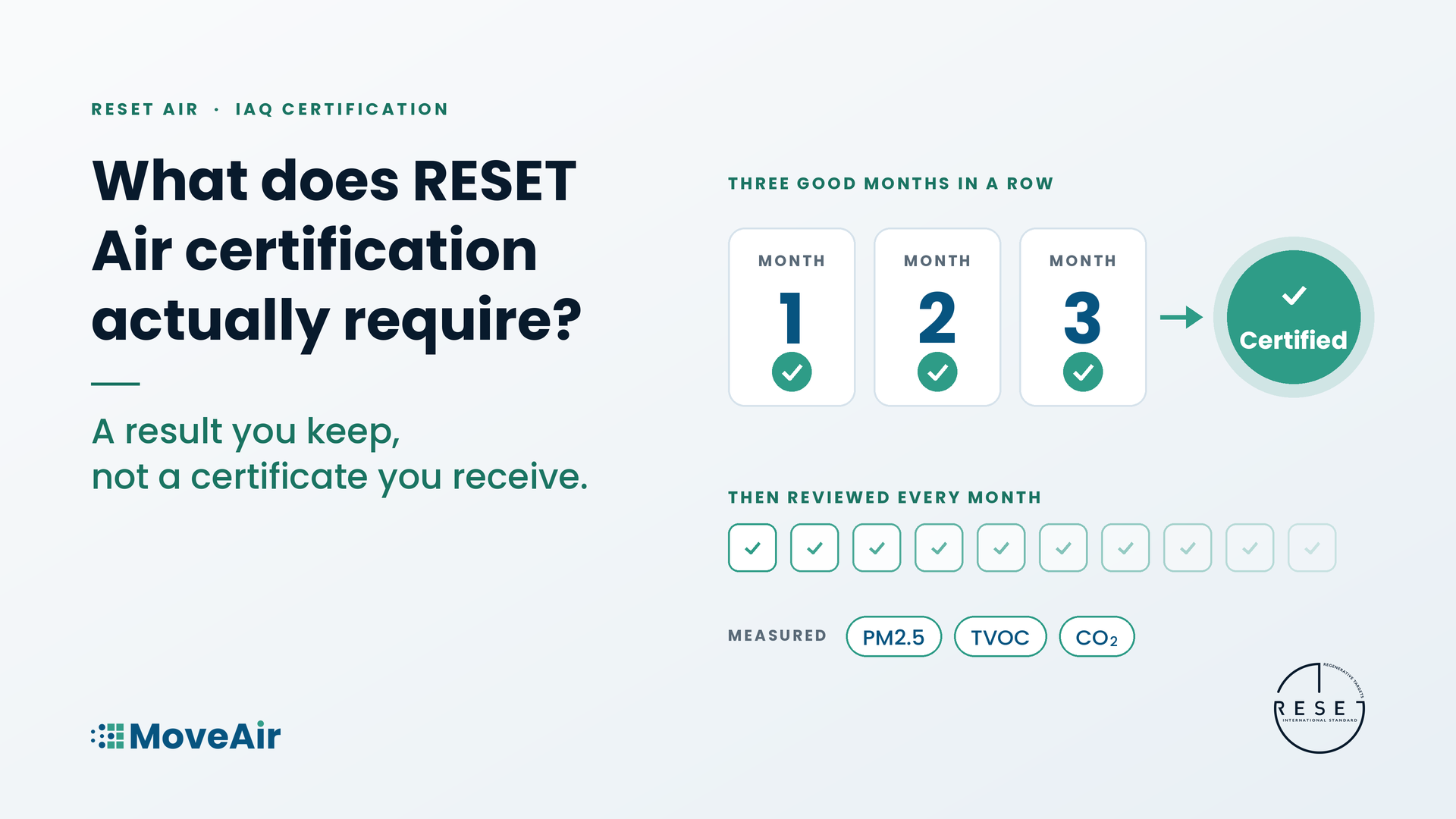
The short answer: RESET Air checks the air in your building using sensors, every month. It does not look at drawings or design plans. To get certified, the sensors must show three months in a row of good air quality. To stay certified, the air has to stay good.
That is what makes RESET Air different. It is not a certificate you receive once. It is a result you keep.
What does RESET Air measure?
RESET Air looks at three things:
- PM2.5: fine dust and particles, from outdoor pollution, traffic or cooking
- TVOC: chemical vapours from furniture, paint, carpets and cleaning products
- CO₂: a simple sign of how well a room is ventilated
For office interiors, the air must stay below these levels:
- PM2.5 below 35 µg/m³
- TVOC below 500 µg/m³
- CO₂ below 1,000 ppm
RESET looks at the average for each day, counting only the hours the building is in use.
Temperature and humidity are measured too, but they do not decide whether you pass.
A new version of the standard, v2.1, is still in draft. It would tighten the dust limit to 25 µg/m³.
How do you get certified?
There are five steps:
- Register the project with RESET, through a RESET-trained consultant.
- Share your plan: where the sensors will go and how they connect.
- Show the installation, with photos and serial numbers, for an on-site or online check.
- Collect data for three months. Every month must meet the targets. A bad month restarts the count.
- Keep going. RESET reviews the data every month, with an annual fee.
What happens if the air gets worse?
One bad month does not cost you the certificate. Three bad months in a row do. To get it back, you need three good months in a row.
This is the point of RESET Air. It shows what the air is like now, not on the day the certificate was issued.
How many sensors do you need?
For office interiors, RESET asks for:
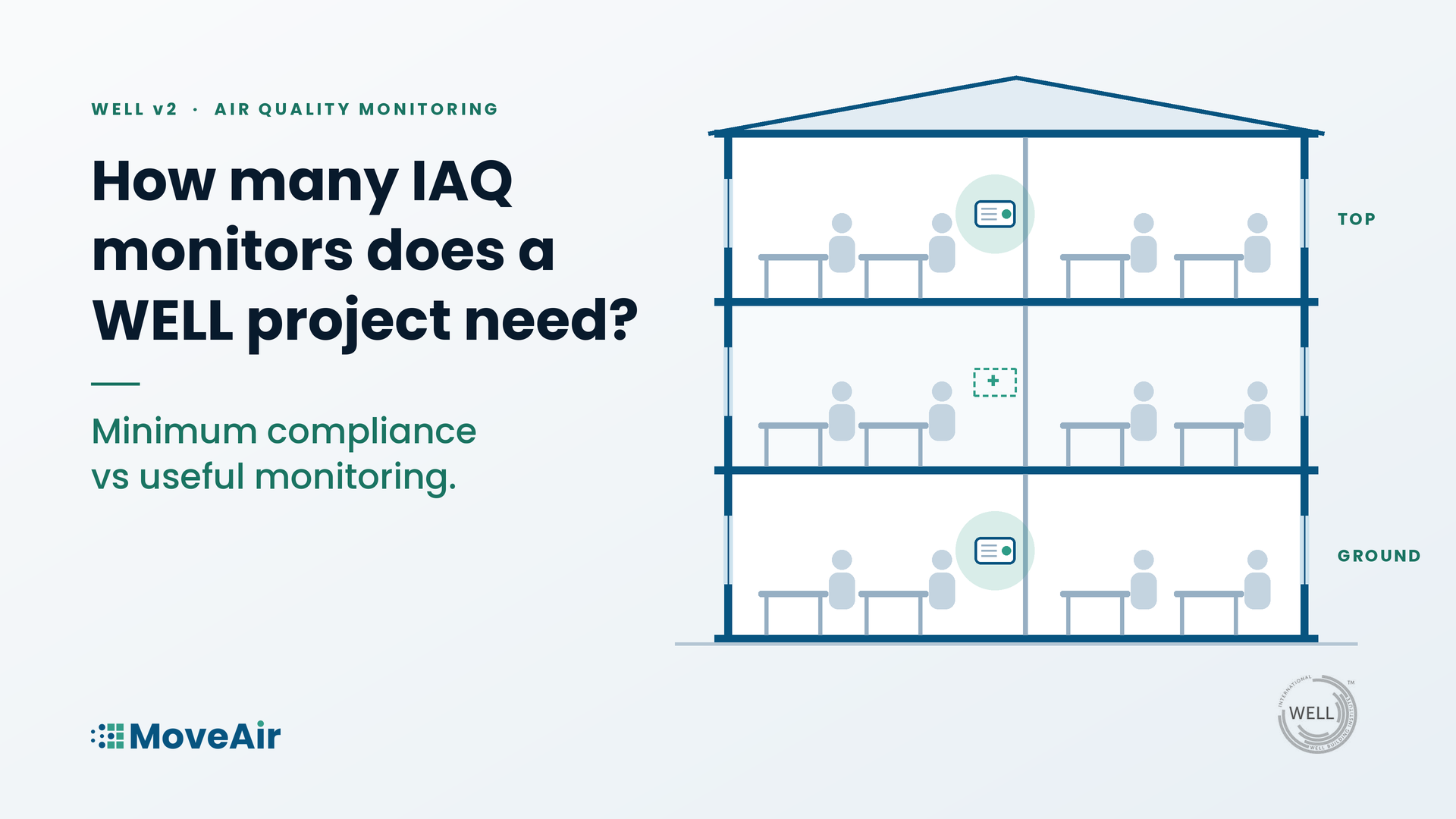
- at least one sensor in every type of regularly used space, such as open office, meeting room or reception
- sensors that represent at least 80% of the people in the building
- no more than 500 m² of open space per sensor
Example: a 2,000 m² open-plan office needs at least four sensors (2,000 ÷ 500). Meeting rooms and other room types may add more.
If the same office is also going for WELL, WELL asks for one sensor per 325 m², which means seven. When we plan for both, the stricter rule sets the number.
Can you use any sensor?
No. Only sensors on RESET’s approved list can be used, and only Grade A or Grade B. The data must also reach RESET through an approved data platform.
Check this before you buy hardware, not after.
Does RESET Air help with WELL?
Yes. RESET and IWBI, the organisation behind WELL, publish an official link between the two standards. A RESET Air certification can count towards some WELL requirements, as long as it stays active.
WELL also accepts RESET-approved sensors of Grade B or above. So with good planning, one set of sensors can serve both.
Common mistakes
The targets are rarely the hard part. Day-to-day operation is.
What we see most often:
- buying sensors before checking they are RESET approved
- not defining the building’s working hours clearly
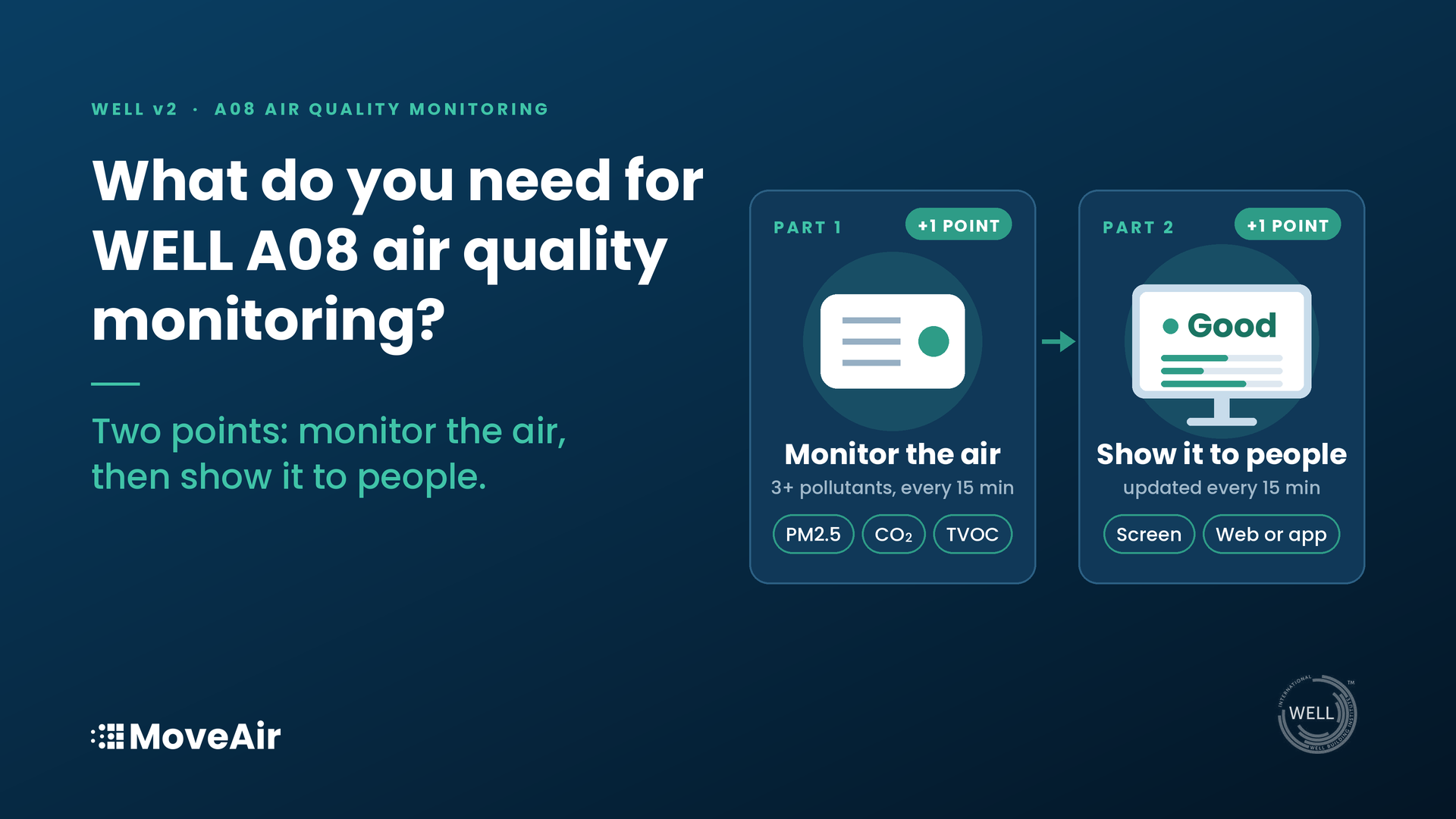
- forgetting that people in the building must be able to see the hourly readings
- stopping maintenance after the first three months
- placing sensors where installation is easy, not where people actually work
The short version
- RESET Air measures dust, chemical vapours and CO₂ in your building.
- You need three good months in a row to get certified.
- You keep the certificate by keeping the air good.
- Use RESET-approved sensors, and enough of them.
- Make the readings visible to the people in the building.
Planning a RESET Air project?
MoveAir can review your floor plans, work out how many sensors you need for RESET Air and WELL together, and set up screens and dashboards so everyone can see the air quality.
Our monitors are RESET Air approved at Grade B, so the same hardware works for both RESET and WELL. Our team also includes a RESET Air Accredited Professional.
Healthy Buildings. Made Measurable.
FAQ
How long does it take to get RESET Air certified?
At least three months of good data, after the plan and the installation are approved.
Does RESET Air certification expire?
Not on a set date. It stays active while the air stays good and the annual fee is paid. Three bad months in a row cancel it.
What does RESET Air measure?
Fine dust (PM2.5), chemical vapours (TVOC) and CO₂. Temperature and humidity are measured too, but they don’t decide whether you pass.
Can I use any air quality monitor?
No. Only monitors on RESET’s approved list, at Grade A or Grade B.
Do people in the building need to see the data?
Yes. Hourly readings for PM2.5, CO₂ and TVOC must be available to the people in the building.
Sources
- RESET Air standard: reset.build/standard/air
- RESET Air certification process: reset.build/programs/projects/air/process
- RESET Air project requirements: reset.build/programs/projects/air
- RESET Air FAQ: reset.build/programs/projects/air/faq
- RESET Air v2.1 change log: reset.build/standard/air/v2_1/changelog/interiors
- WELL Performance Verification Guidebook (IWBI)