PM2.5 is fine dust that floats in the air. You cannot see it, smell it or feel it, but it can reach deep into your lungs.
That is why it is one of the most important things to measure indoors. A room can look perfectly clean and still have high PM2.5.
What is PM2.5?
PM stands for particulate matter. PM2.5 means particles 2.5 micrometres across or smaller. A human hair is about 30 times wider (EPA).
PM2.5 is not one pollutant. It is a size group: a mix of tiny solid particles and droplets from traffic, cooking, smoke and more. They are light enough to stay in the air for hours.
Why does PM2.5 matter for health?
Bigger dust gets caught in your nose and throat. PM2.5 is small enough to get past them and reach deep into the lungs. The smallest particles can even pass into the bloodstream.
Long-term exposure is linked to heart disease, stroke, lung disease and lung cancer (WHO). Short peaks can make asthma worse.
What is a healthy PM2.5 level?
There is no single indoor limit, but these numbers help:
- WHO guideline: 15 µg/m³ over 24 hours, and 5 µg/m³ as a yearly average. These are health guidelines, not legal limits.
- EU outdoor limit: 25 µg/m³ as a yearly average today, tightening to 10 µg/m³ from 2030.
- WELL v2: 15 µg/m³ or less in on-site testing.
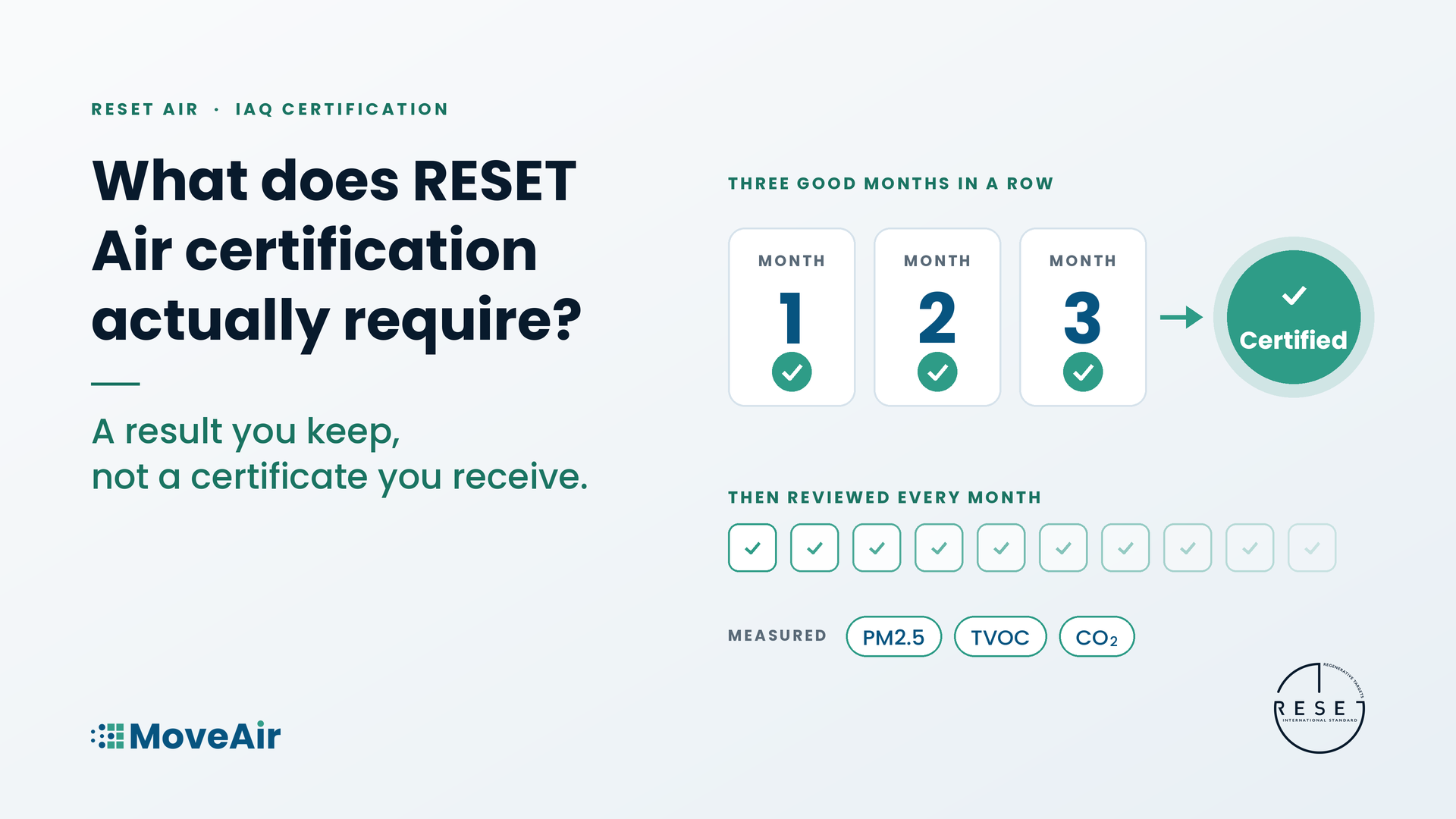
- RESET Air: below 35 µg/m³ as a daily average over occupied hours, for office interiors.
Lower is always better.
Where does PM2.5 come from?
- Traffic: exhaust, tyre and brake wear, and road dust. Buildings near busy roads or car parks get more.
- Cooking: frying and grilling can push levels up within minutes, on gas and electric hobs alike. Weak or switched-off extraction spreads it through the building.
- Smoke: candles, smoking and wildfires. Wildfire smoke can travel hundreds of kilometres and affect buildings for days.
- Outdoor air: whatever is outside can come in.
How does outdoor PM2.5 get inside?
Through ventilation, open windows, doors and small gaps in the building.
How much gets in depends on the building. Good filters can keep indoor levels well below outdoor levels. In a naturally ventilated building, or one with poor filters, indoor levels often follow the outdoor air closely.
There is no fixed rule for how much comes in. The only way to know is to measure.
Why measure PM2.5 continuously?
Because you cannot sense it. Without a monitor, there is no way to know what people are breathing.
A one-off test shows one moment. Continuous monitoring shows the full picture:
- traffic peaks at rush hour
- spikes when someone is cooking
- smoke coming in from outside
- differences between rooms and floors
- whether the filters are doing their job
Comparing indoor and outdoor readings also tells you where the problem comes from. If indoor levels follow the outdoor air, look at filters and ventilation. If they spike on their own, look for a source inside, such as a kitchen with weak extraction.
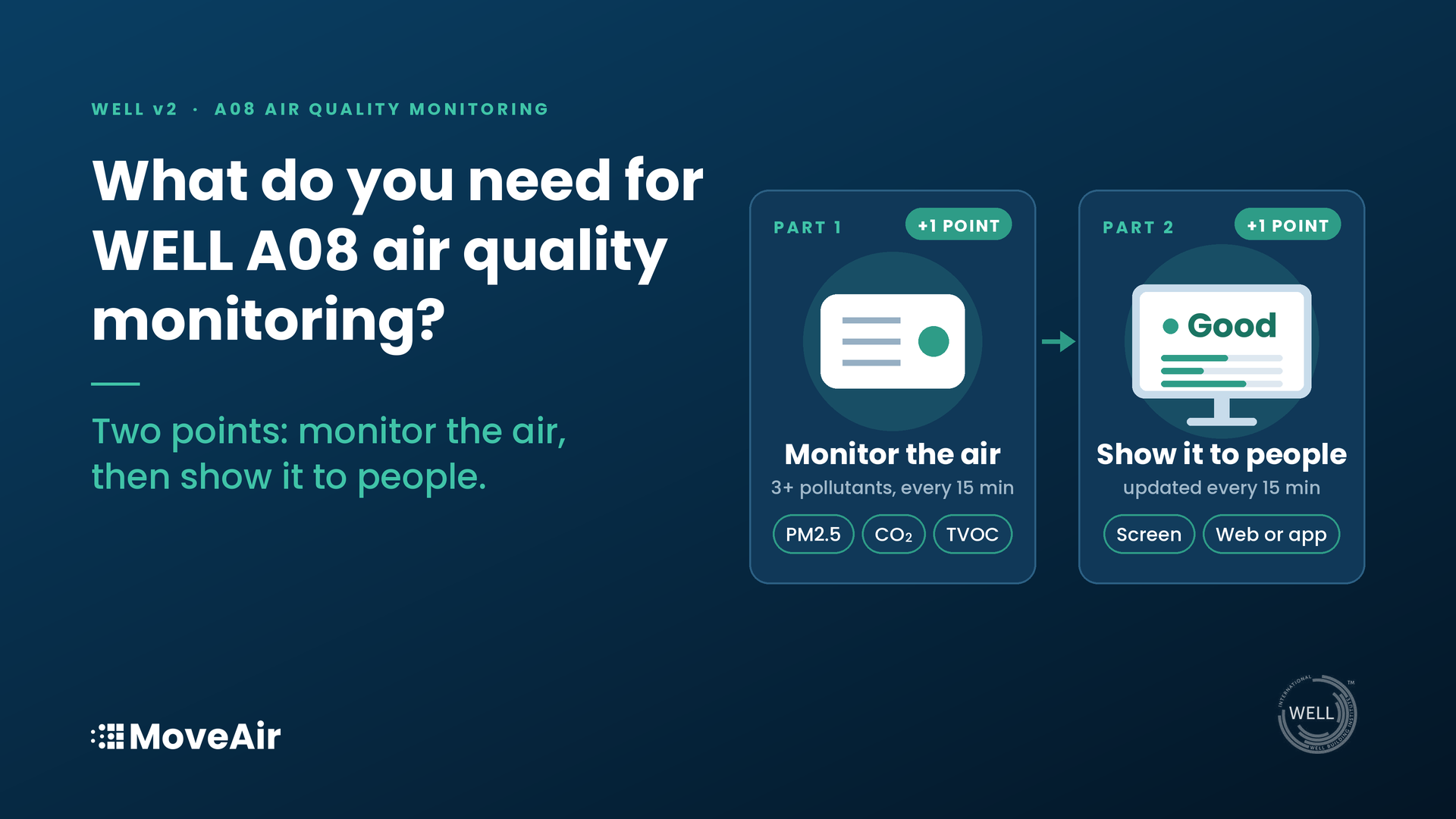
Continuous PM2.5 data is also what certifications like RESET Air rely on. More in What Does RESET Air Certification Actually Require? and WELL vs LEED vs RESET Air. For how many monitors you need and where to place them, see How Many IAQ Monitors Does a WELL Project Need?
FAQ
What does PM2.5 stand for?
Particulate matter 2.5: particles 2.5 micrometres across or smaller.
Can you see or smell PM2.5?
No. At normal indoor levels it is invisible and has no smell. A room can look clean and still have high PM2.5.
What is a healthy PM2.5 level indoors?
The WHO guideline is 15 µg/m³ over 24 hours and 5 µg/m³ over a year. Lower is better.
Do filters and air purifiers help?
Yes. Good filters and purifiers can lower PM2.5 a lot. A monitor shows whether they are actually working in your space.
Does cooking on an electric hob avoid PM2.5?
No. Frying and grilling create particles on any hob. Good extraction is what makes the difference.
See your building’s air
MoveAir measures PM2.5, CO₂ and other pollutants continuously and shows them on one dashboard. Explore the platform or book a demo.
Healthy Buildings. Made Measurable.