In 2015, a huge gas leak near Los Angeles led to air filters being installed in every nearby school. Nobody planned it as an experiment, but it became one of the clearest studies we have on what cleaner classroom air does for learning.
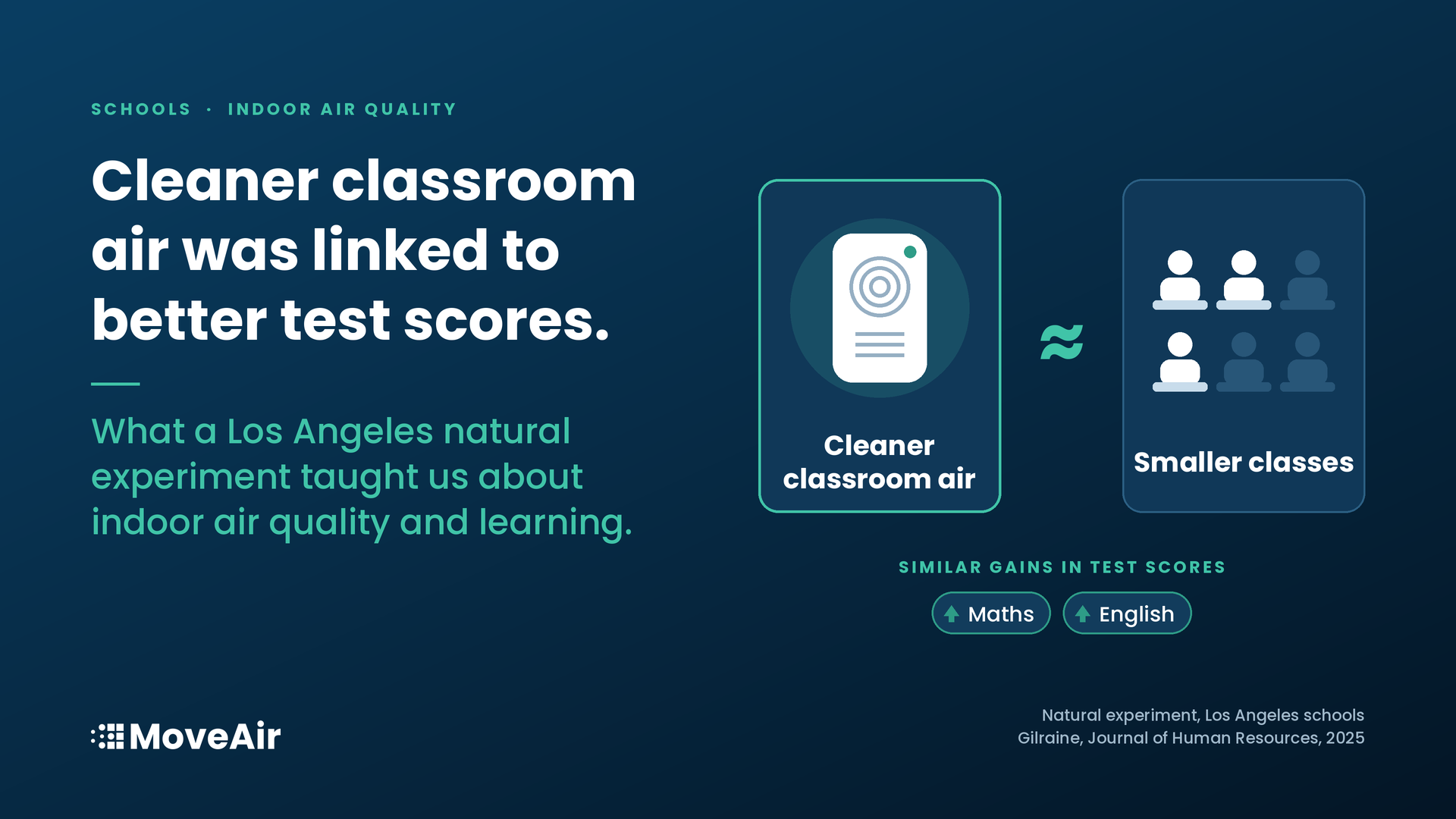
Pupils in schools with filters scored higher in maths and English. The researcher says the gains were about as large as cutting class sizes or giving pupils intensive tutoring.
What happened?
In October 2015, the Aliso Canyon gas storage site in Los Angeles started leaking. It became the largest natural gas leak in US history.
The gas company installed air filters in every classroom, office and common area of every school within five miles of the leak. Schools further away did not get them.
That five-mile line created a natural experiment. Economist Michael Gilraine compared schools just inside it with schools just outside it. Same area, similar pupils, similar outdoor air. The main difference was the filters.
What did the study find?
- Test scores in schools with filters rose by 0.1 to 0.2 standard deviations in maths and English (Gilraine, Journal of Human Resources, 2025).
- The gains lasted into the following school year.
- The results held after accounting for pupils’ backgrounds and where they lived.
In education research, that is a big effect for a single change. Gilraine compared it to reducing class sizes or providing intensive tutoring (Education Week).
The surprising part: the leak was not the problem
Air tests inside the schools, taken before the filters went in, found no natural gas pollutants (Gilraine, 2020).
So the filters did not clean up the leak. They most likely removed the everyday pollution that is in many classrooms anyway.
That is why the result matters far beyond Los Angeles. Filters are also cheap compared with hiring more teachers, and Gilraine calls them a highly cost-effective way to raise results.
Do air filters solve classroom air quality?
Not on their own. Filters remove particles such as PM2.5. They do nothing for CO₂, which builds up when a full classroom does not get enough fresh air.
That matters too. A review of classroom studies predicted that cutting CO₂ from 2,100 to 900 ppm would make schoolwork about 12% faster, with fewer errors (Wargocki et al., 2020). Here CO₂ works mainly as a marker of how well the room is ventilated, not as the single cause.
So the best classrooms get both: ventilation for CO₂ and filtration for particles. If PM2.5 is new to you, start with What Is PM2.5 and Why Should Buildings Measure It?
What about schools in Europe?
A 2024 study in Bucharest measured six classrooms across four schools and two kindergartens, all ventilated only by windows and doors (Vasile et al., Atmosphere, 2024).
- Average CO₂ was above 1,000 ppm in all six rooms.
- Average PM2.5 and PM10 were above the limits in all six.
- Four of the six buildings had already been thermally renovated.
The researchers then followed a seventh classroom before and after a heat recovery ventilation unit was installed. Over about eight months:
- average CO₂ fell by 33.5%
- PM2.5 fell by 34.6% and PM10 by 31.1%
- days above 1,000 ppm went from 40.9% to none
Our founder Maciek Wysota went through the full study on LinkedIn.
Different country, different fix, same lesson. Classroom air can be measured, and it can be improved.
Why schools are top of our list
Classrooms are some of the most crowded rooms in any building. Twenty or thirty people share one room for hours, and the people breathing that air are children.
Yet schools get far less attention than offices. Most monitoring and budgets still go to commercial buildings, and many classrooms have never been measured at all.
That is what concerns us most. Not every school needs a sophisticated system. But before choosing ventilation, filtration or anything else, it helps to know what is actually happening.
Measure first. Then fix the right problem.
The short version
- Air filters in Los Angeles schools raised test scores about as much as smaller classes.
- The filters most likely worked by removing everyday pollution, not the gas leak.
- In Bucharest, ventilation cut CO₂ and particles by about a third.
- Filters handle particles. Ventilation handles CO₂. Measure both.
FAQ
Do air filters improve school results?
The Los Angeles study found clear gains in maths and English. It is strong evidence from one setting, not a promise that every installation will give the same result.
Do air purifiers lower CO₂?
No. They remove particles. CO₂ only comes down with more fresh air.
Does a renovated school automatically have good air?
No. Renovation makes buildings more airtight, and without proper ventilation stale air stays in. Four of the six Bucharest buildings had been renovated, and all six were over the CO₂ limit.
How do you know what a classroom needs?
Measure PM2.5 and CO₂ for a few weeks. If PM2.5 is high, filtration helps. If CO₂ is high, ventilation is the fix.
Working on a school project?
MoveAir monitors PM2.5, CO₂ and comfort in classrooms and shows where filters or better ventilation would make the biggest difference. If you run a school, manage school buildings or fund school projects, we would like to hear from you. Talk to us.
Healthy Buildings. Made Measurable.
Sources
- Gilraine, M. (2025). Air Filters, Pollution, and Student Achievement. Journal of Human Resources
- Gilraine, M. (2020). Air Filters, Pollution and Student Achievement. EdWorkingPaper, Annenberg Institute at Brown University
- Education Week (2020). Air Filters: A Potential Tool to Boost Learning
- Vasile, V., Catalina, T., Dima, A. and Ion, M. (2024). Pollution Levels in Indoor School Environment: Case Studies. Atmosphere
- Wargocki et al. (2020). The relationships between classroom air quality and children’s performance in school. Building and Environment