WELL, LEED and RESET Air are three building certifications. People often mention them together, but each one answers a different question:
- WELL: is this building good for the people inside it?
- LEED: is this building good for the environment?
- RESET Air: can this building prove its indoor air is good, every day?
WELL and LEED look at the whole building, and air is one topic among many. RESET Air looks only at indoor air, and it measures it all the time.
What is WELL?
WELL is about people’s health and wellbeing. It covers ten areas, including air, water, light, sound, thermal comfort and mind.
Some requirements are mandatory. Others are optional and earn points. More points means a higher level: Bronze, Silver, Gold or Platinum.
Before certification, an independent tester checks the space on site, including the air. The certificate lasts three years, then the building is checked again.
What is LEED?
LEED is about environmental impact: energy, carbon, water, materials and transport. Indoor air quality is one part of it.
It also has mandatory requirements and optional points, with four levels: Certified, Silver, Gold and Platinum.
LEED is mostly checked through design documents and calculations. A new building is certified once, when it is finished. An existing building is certified on its real performance and has to renew every three years.
What is RESET Air?
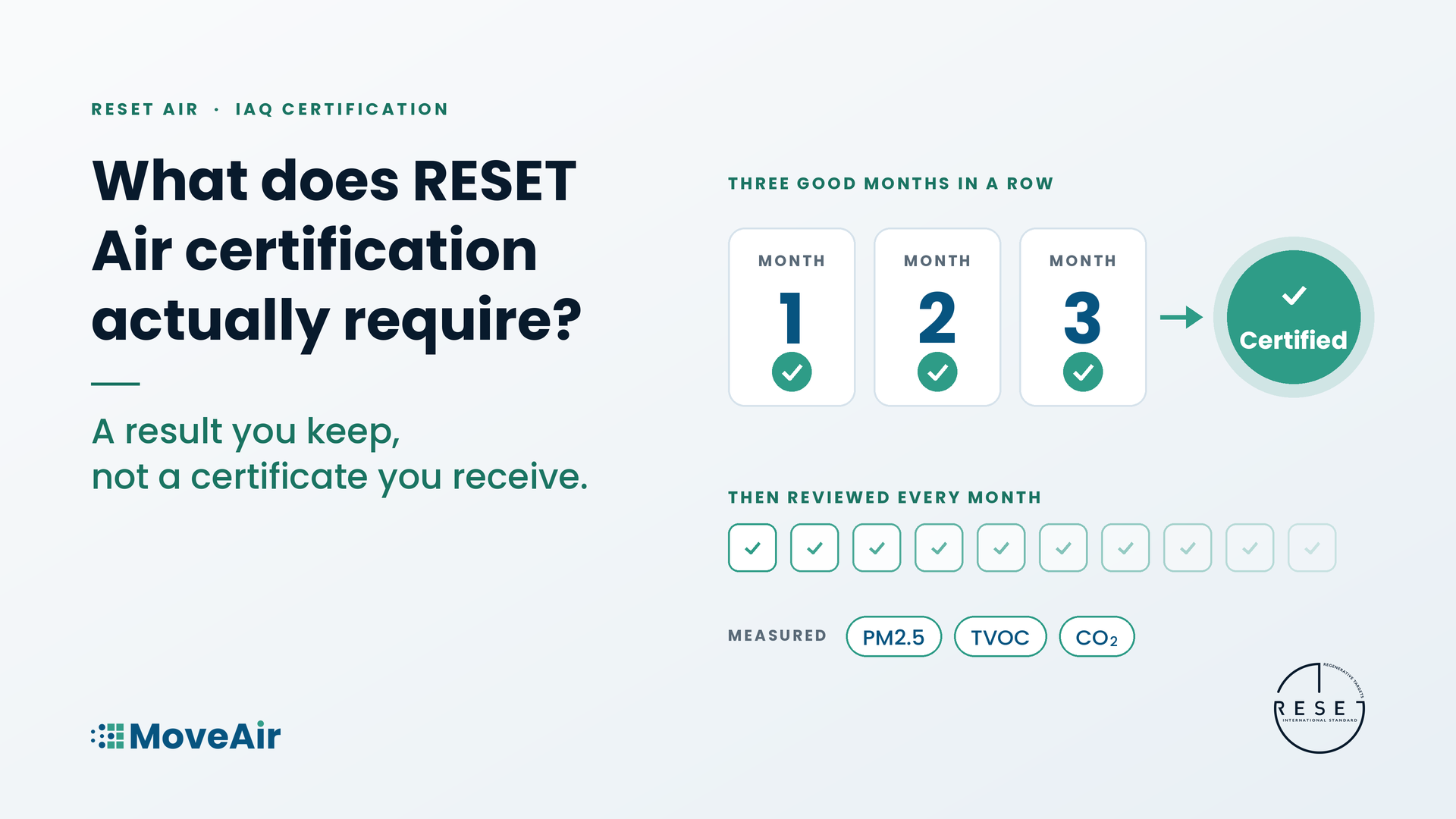
RESET Air is only about indoor air. Monitors in the space measure it continuously:
- PM2.5 (fine dust)
- TVOC (chemical vapours)
- CO₂ (a sign of how well the space is ventilated)
- temperature and humidity
To get certified, the air has to stay within its targets for three months in a row. After that, the data is checked every month. If the air fails three months in a row, the certificate is taken away.
So RESET Air is not a certificate you receive once. It is a result you keep. We explain it step by step in What Does RESET Air Certification Actually Require?
What is the main difference?
How each one proves it.
- WELL tests the air on site, on one day, and again three years later.
- LEED mainly checks that a new building was designed well, with good ventilation and good filters.
- RESET Air needs real data, every day.
A building that was designed well is not always running well. Filters get dirty. More people move in. Ventilation gets turned down to save energy. A one-day test cannot show that. Continuous monitoring can.
Can a building have more than one?
Yes. Many buildings hold WELL and LEED together, and RESET Air data can support WELL. One well-planned set of monitors can often serve all three.
Which one should you choose?
Start with what you want to prove, and to whom.
- Investors and environmental reporting: usually LEED.
- Employees and their health: usually WELL.
- Tenants or staff asking how the air is today: RESET Air.
The key is not to chase logos. Pick the one that matches the claim you want to make.
FAQ
Is WELL better than LEED?
No. They measure different things. WELL is about people, LEED about the environment. Many buildings have both.
Do WELL or LEED require air quality monitors?
No. Both reward continuous monitoring, but neither requires it. RESET Air does.
How long does each certificate last?
WELL lasts three years. LEED for a new building does not expire. LEED for an existing building lasts three years. RESET Air lasts as long as the air keeps meeting its targets.
Can one set of monitors work for all three?
Often, yes, if the monitors are accurate enough for the strictest standard and placed correctly. RESET Air accredited monitors are a good starting point.
What do Grade A and Grade B mean in RESET Air?
They describe how accurate the monitor is, not how clean the air is.
Not sure which fits your building?
MoveAir can help you choose the right certification and plan one monitoring setup that works for all of them. Talk to us.
Healthy Buildings. Made Measurable.